Can writing poetry be learned, or is poetic talent something a person is simply born with? This question is an excellent starting point for a workshop with children and young people. The answer lies somewhere in between: no one can promise to turn every child into a poet, but almost every child can learn how to express themselves through verse, choose words more carefully, and use poetry to transform thoughts, images, and feelings into something of their own.
That is precisely why a poetry-writing workshop can be much more than a literature class.
When is the best time to start?
Children can start exploring poetry at a very early age. In fact, they encounter its basic elements long before they understand terms such as “verse”, “rhyme” or “metaphor”. Nursery rhymes, lullabies, word games, and children’s songs already introduce them to the rhythm and sounds of language.
For organised creative writing workshops, the age group from approximately 9 to 15 years is particularly interesting, with activities adapted to different age groups.
Children aged around 9 to 11 tend to respond better to games, rhymes, humour, unusual words, and short exercises. For example, a child might be asked to write four lines about rain without using the word “rain”.
From the age of 12 onwards, more complex themes can be introduced, including emotions, friendship, family, the city, nature, fears, growing up, and the way young people see the world around them. For teenagers, poetry can become particularly engaging because it offers a space to express things that are sometimes difficult to put into ordinary sentences.
But how can you teach someone to write a poem?
The most important thing is not to start with definitions.
If the first workshop begins with the question “What is a metaphor?”, there is a risk that creative writing will quickly start to feel like just another school lesson. It is much more interesting to begin with a challenge:
Describe the sea to someone who has never seen water.
Or:
Write five words to describe your day, but none of them may name an emotion.
These small language games can easily lead to writing verse.
The workshop facilitator can then demonstrate how an ordinary sentence changes when an image, rhythm, or comparison is added. The sentence “I was sad” can become “I carried a cloud in my pocket”. In this way, children discover metaphors in practice before they even need to learn the term.
Poetry does not have to rhyme
One of the first obstacles children often face is the belief that a poem must rhyme. When they try to find a word that rhymes with the previous line, meaning very quickly becomes secondary to rhyme.
That is why it is useful to introduce different forms of poetry: rhyming poems, free verse, very short poems, haiku, acrostics, and even texts that fall somewhere between a poem and a short story.
Children then receive an important message: there is no single correct way to write a poem.
What might a workshop look like?
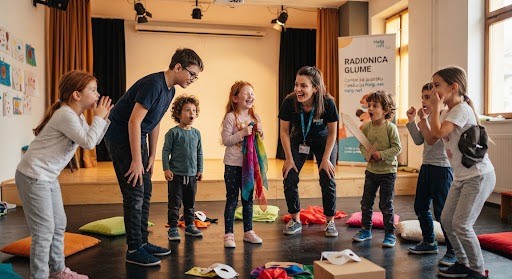
A workshop can begin with a short association game. The facilitator says a word, such as “window”, and each child shares the first image, sound, colour, or memory that comes to mind.
Next, the group reads several carefully selected poems and discusses them without the usual school-style question, “What did the poet mean?” Much more interesting questions include: Which line would you remember? What image did you picture while listening to the poem? Which word would you change?
A short creative exercise follows. Participants might draw three random words that they must use in a poem, write a poem from the perspective of an everyday object, or describe a familiar place as if they were seeing it for the first time.
Only then does the individual writing begin.
At the end, those who wish to do so can read their work to the group. It is important that reading aloud should not be compulsory. The workshop should be a space where children feel free to experiment, write something unusual, make mistakes, cross out half the text, and start again.
How can you engage a child who says, “I don’t know how to write poetry”?
The best response is not, “Of course you do.”
It is better to give the child a task that requires no knowledge of poetry at all.
“Write down three things you saw today.”
“What colour is Monday?”
“What would silence sound like if it had a sound?”
“If your schoolbag could talk, what would it complain about?”
The answers could already be the beginning of a poem.
It is particularly useful to connect poetry with the world young people know. Song lyrics, rap, spoken word, short-form content on social media, or a line from a favourite book can all serve as starting points for exploring rhythm, language, and self-expression.
The facilitator’s role is not to create “little poets”
A good creative writing workshop should not be a competition to see who has written the “most beautiful” poem.
Above all, the facilitator should help each child discover their own voice.
Instead of saying “this is good” or “this is not good”, it is more helpful to say, “I find this line particularly interesting”, “I can really picture the image you are describing here”, or “What would happen if you removed this word?”
In this way, children also learn something important that professional writers know well: the first draft is not necessarily the final one. Writing involves revising, shortening, searching for a more precise word, and rereading one’s own work.
What if a child has no “talent”?
Perhaps that is not even the right question.
The aim of a workshop does not have to be to create future writers. Creative writing encourages more thoughtful use of language, imagination, observation, the ability to express ideas, and confidence in turning one’s thoughts into text.
One child may continue writing poetry after the workshop. Another may discover a preference for stories. A third may never write another poem, but might begin to read literature differently or listen more attentively to the lyrics of a favourite song.
And that is a success, too.
From a blank page to the first poem
Perhaps the most beautiful thing a writing workshop can show a child is that a blank page is not a test with one correct answer.
It is a space.
At first, there may be just one word. Then another. Together, they create an image; the image becomes a line of poetry, and a few lines become something that did not exist half an hour earlier.
That is why we do not need to teach children how to be poets first.
It is enough to teach them to pause, look at the world a little more carefully, and try to find their own words for what they see and feel.
The poem can come later.